何を探していますか?

A knitted wire mesh sleeve can match the nominal diameter on a purchase order and still fit differently on the assembly line. The missing information is often the measurement condition: was the mesh measured loose, opened over a mandrel, or fitted to the bellows?
To size a knitted wire mesh sleeve for exhaust bellows, define the bellows outside profile, the mesh measurement state and the required installed coverage. Establish the cut length using the specified mesh construction, then record the method used to inspect repeat orders.
This guide focuses on dimensional specification for exhaust bellows and flex pipe manufacturers. For the construction and application background, see how knitted wire mesh is used in exhaust bellows and flexible exhaust pipes.
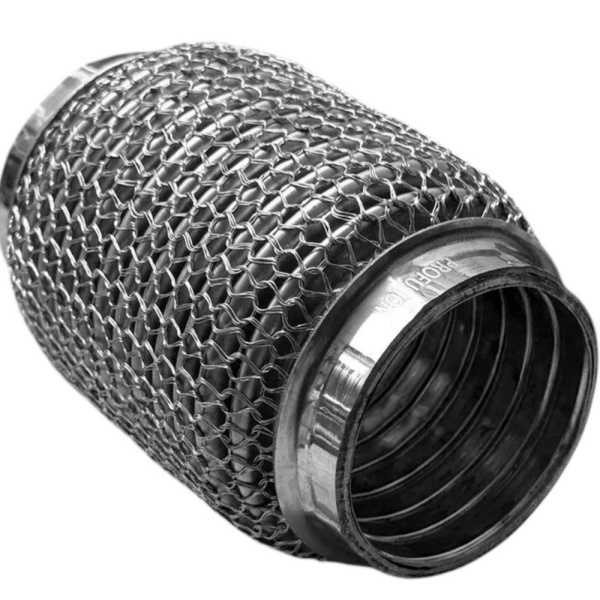
Knitted stainless steel mesh has interconnected loops that can move relative to one another. Its shape can change with handling, stretching and compression. A dimension taken from an unsupported sleeve therefore needs a different definition from one checked over a rigid gauge.
Use clear terms in the drawing or inspection instruction:
Free-state inspection describes the supplied part. A mandrel provides a controlled dimensional reference. Installed inspection shows how the mesh occupies the available space in the assembly. These are inspection conditions to agree for the project; a mandrel check is not a universal requirement for every mesh sleeve.
A loose sleeve may not remain circular. If lay-flat width is used for inspection, identify it as lay-flat width and define how the sleeve is arranged. Avoid compressing the mesh with caliper jaws and recording the reading as an unrestricted diameter.
Begin with the bellows outside profile and the intended mesh location. The exhaust pipe bore does not define the mesh sleeve diameter.
Check the largest outside diameter that the sleeve must pass over during assembly, along with the diameter of the section it will cover. End collars, weld features and changes in profile can affect the installation route even when the mesh fits the central bellows section.
The surrounding components also matter. An exhaust bellows mesh sleeve fitted directly around the bellows may have different space and contact requirements from mesh positioned beneath an outer braid. Define the intended contact condition through the drawing, approved sample or assembly requirement.
There is no single clearance percentage that suits every knitted structure and bellows design. Establish the required fit on the intended assembly and use that result to set the inspection method.
| Drawing or Enquiry Item | What to Define |
|---|---|
| Bellows geometry | Outside profile, covered section and features the sleeve must pass over. |
| Sleeve diameter | Measurement state, gauge or method, and agreed tolerance. |
| Sleeve length | Free or installed length, end positions and agreed tolerance. |
| Wire construction | Alloy, individual wire diameter, wires knitted together, layer count and construction reference. |
| Mesh consistency | Agreed mass-per-length or construction check, with its measurement conditions. |
| End arrangement | Retained zones, overlap, cut-edge requirements and clearance from moving components. |
| Supply condition | Continuous tubing or cut pieces, packing requirements and approved sample reference. |
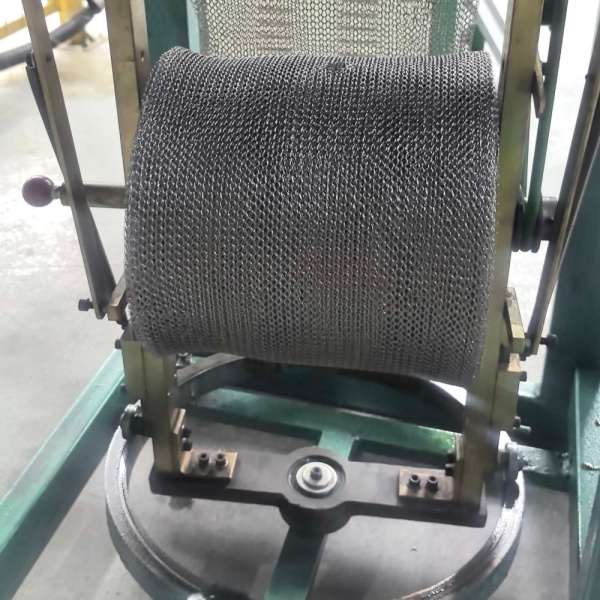
Opening tubular knitted mesh to fit a larger circumference can change its axial length and apparent openness. The response depends on the knitting structure, wire configuration and handling. Do not assume a fixed conversion between sleeve diameter and length.
This matters when purchasing knitted wire mesh tubing in rolls. A length measured along loosely supplied tubing may cover a different distance after the mesh has been opened and fitted to the bellows.
Mark where the installed mesh begins and ends. If part of the sleeve is retained beneath an end component, distinguish that retained section from the mesh covering the active bellows.
For a new design, establish the cut length through an assembly trial using the intended mesh construction. Record the cutting condition and installed result together. A later change to the mesh construction should trigger a review of that relationship.
Mass per unit length can help compare knitted mesh samples and production batches when the length measurement is consistent. Record the sample mass and the corresponding reference length:
Mass per unit length (g/m) = sample mass (g) / reference length (m)
Define how the sample is arranged during measurement and whether end treatments or additional components are included. Stretching a sample changes the length used in the calculation. Readings taken under different conditions can suggest a material difference that is actually a measurement difference.
Grams per meter does not fully describe the mesh. Different combinations of wire diameter, strand count and loop structure can produce similar mass values while behaving differently during assembly. Retain the wire and construction specifications alongside the mass check.
Keep strand count and layer count separate. Triple-wire knitted mesh describes three wires knitted together into the loop structure; it does not mean three separate mesh layers. Neither description replaces a dimensional or construction specification.
If the drawing uses the term mesh density, define the quantity, unit and measurement method. Mass per unit length, stitch count and the bulk density of a compressed mesh component are different measurements.
Continuous knitted wire mesh tubing allows the customer to control cutting within its production process. Cut-to-length sleeves move that operation to the mesh supplier. Either format needs a defined cutting and handling method.
For continuous tubing, document the condition used when measuring the cut length. The production instruction should also address loose wire ends, distortion during handling and transfer of the cut pieces to assembly.
For finished sleeves, agree the supplied length condition and packing arrangement. Mesh compressed or stretched during packing should be prepared for inspection using the agreed method before measurements are compared.
Keep the approved sample with the dimensional drawing and identify the construction revision it represents. A sample without a revision record becomes difficult to use after a material or knitting change.
An exhaust flex pipe mesh sleeve that fits over a bellows is ready for assembly evaluation. That fit check does not establish the performance of the finished flex pipe.
Check its position after the ends are retained and through the movement specified for the assembly. Look for bunching, migration, unwanted contact and interference with adjacent layers. Confirm that the mesh stays within the region intended by the design.
The knitted mesh is a porous metallic component. It does not provide the gas-tight function of the bellows. Where leakage, vibration, thermal cycling or durability requirements apply, assess them on the relevant completed assembly using the exhaust manufacturer's acceptance criteria.
Before releasing repeat orders, capture the dimensions and conditions that made the sample acceptable. Keep the free-state measurements, mandrel details where used, installed positions, cutting method and construction revision together. Review the fit if the bellows profile, end arrangement or mesh construction changes.
Start with the outside profile at the mesh installation position, including any features the sleeve must pass over. Pipe bore and bellows outside diameter are different dimensions. The intended contact condition and measurement method must also be specified.
Check it in an assembly trial. A construction change can alter handling and installed coverage even when the nominal sleeve diameter remains the same.
No. Compare the alloy, wire diameter, strand and layer counts, knit construction, dimensional conditions and installed fit. Mass per unit length is one consistency check; it does not establish equivalent damping or durability.
BSTFLEX supplies stainless steel knitted wire mesh sleeves for exhaust bellows and flex pipes, with custom wire construction, sleeve dimensions and cut or continuous supply.
For quotation and sample evaluation, send the bellows drawing or sample to BSTFLEX with the required mesh location, measurement conditions, preferred material, sample quantity, production order quantity and estimated annual demand. State whether supply is required in pieces or meters.
For other components in the same exhaust project, explore our exhaust heat shields and insulation products.

No.10, Chuangxin North Road, Nanshan Park, Ningguo Economic and Technological Development Zone, Ningguo City, Anhui Province, China
tel/Whatsapp : 0086-15856303740
Eメール : sales@bstbraidedsleeve.com
Skype : vanesa-cheng